VRF vs Multi Split Air Conditioning
Are you wanting to heat or cool four or more zones across a single property?, sometimes simultaneously? If you’ve ruled out a standard ducted air conditioning installation (either because the layout doesn’t suit it, or because you want independent control of each zone) you’ll likely land on two options. They look similar on paper: a multi-split system, or a Variable Refrigerant Flow (VRF) system.
They both share the same basic idea. One outdoor compressor unit feeds refrigerant through copper pipework to multiple indoor units, each heating and cooling its own space, offering independent room-level control. But underneath that surface similarity, they’re built around different engineering philosophies, and the gap between them shows up in cost, capability, scalability, and how well they work during extreme weather events and put under demand.
We’ve installed both VRF and multi head air conditioners across Melbourne. In this article, we compare VRF vs multi split air conditioning, so you can make the best choice for your home.
The quick answer
Multi-split is the right system for most homes with two to five rooms that need heating in winter or cooling in summer, where each room is similar in size and use, and where you have a sensible residential budget.
VRF is the right system for larger homes, multi-storey or split level properties, commercial fitouts, mixed-use buildings, and anywhere you need independent zone control across many indoor units. Premium options also allow heating one zone and cooling another at the same time.
We will discuss this in more detail throughout the rest of the article.
Table of Contents
- The quick answer
- What is a multi split air conditioner?
- What is a VRF system?
- Technical differences between VRF and multi split air conditioners
- The feedback from homeowners on multi splits vs VRF systems
- When a multi-split is the right choice
- When a VRF is the right choice
- The hybrid approach
- So, is VRF ducted or ductless?
- How we approach the recommendation
- When it comes to VRF and multi-splits, installer experience matters more than the brand

What is a multi split air conditioner?
A multi split is exactly what the name suggests: a split system air conditioner with multiple indoor units (heads) connected to a single outdoor condenser. Typical residential multi splits support two, three, four, or five indoor heads. Indoor units can be wall-mounted, floor-standing consoles, slim ducted units in the ceiling, or compact cassettes. Each head has its own thermostat and remote, and each can be controlled independently. The outdoor unit uses an inverter compressor. This is a variable-speed compressor that ramps up or down to match the total cooling or heating demand from whichever indoor units are switched on.
The refrigerant circulates between the outdoor condenser and the indoor evaporators as a heat-transfer liquid, picking up heat from one location and releasing it at the other. The same hardware delivers heating in winter by running the cycle in reverse (this is the heat pump principle – the system isn’t generating heat, it’s moving it from outside to inside).
Multi splits suit Australian homes well because Australian summers and winters are mild enough that the heat pump cycle works efficiently in both directions year-round. They’re a well-understood, mature technology, and parts availability across brands like Mitsubishi Electric, Daikin, Fujitsu, Panasonic, and Hitachi is excellent across Melbourne.
For a longer and much more in depth explanation, read our multi-split air conditioning guide.
What is a VRF system?
VRF stands for Variable Refrigerant Flow. VRV (Variable Refrigerant Volume) is Daikin’s trademark for the same technology. They invented it in 1982 and other manufacturers had to use a different name. Whichever badge is on the unit, the underlying engineering is closely related.
A VRF system also uses one outdoor unit (or sometimes two or three linked together) feeding multiple indoor units. But the way refrigerant is distributed inside the system is fundamentally more sophisticated than a multi-split.
In a VRF air conditioning installation, each indoor unit has its own electronic expansion valve. These valves continuously modulate, opening and closing to control how much refrigerant flows to each individual zone in real time, based on what that zone requires at that moment. A central control board running manufacturer-developed software, talks to every indoor unit and to the inverter compressor, calculating the precise refrigerant flow each zone needs and adjusting compressor output to match the combined load.
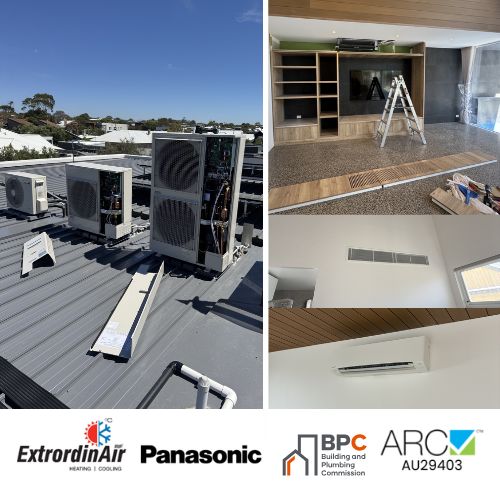
VRF systems also scale much further than multi-splits. A Panasonic Mini VRF can run up to nine indoor units off a single condenser. Larger commercial VRF systems can support twenty or more indoor heads, and multiple outdoor units can be linked together for big multi-storey buildings.
There are three VRF configurations:
- Cooling-only: uncommon in Melbourne’s climate, unless paired with gas ducted heating
- Heat pump: heats or cools the entire system at any one time, with each indoor unit independently controlled within that mode
- Heat recovery: uses a three-pipe refrigerant network with branch selector boxes that can route heating to some zones and cooling to others simultaneously, recapturing waste heat from the cooling side and using it on the heating side
That last configuration is the one that genuinely differentiates VRF from multi-split. A multi-split system can’t heat one room while cooling another. A heat recovery VRF can, and the energy conservation that comes from reusing the waste heat is the technology’s signature efficiency benefit in buildings with mixed thermal loads.
Technical differences between VRF and multi split air conditioners
Refrigerant control
A multi-split has one inverter compressor modulating the refrigerant flow to the whole system. When two heads are on, the compressor runs at the speed needed for those two heads combined. The distribution of refrigerant between heads is handled by simpler valves than a VRF.
A VRF system has electronic expansion valves at every indoor unit, modulating dozens of times a minute. This gives the system far finer control over how refrigerant (and therefore heating or cooling capacity) is distributed across the building, which is what makes the technology scalable to twenty-plus indoor units without losing accuracy.
Capacity sharing and overload
This is one of the most important practical differences, and it’s where multi-splits cause real-world headaches for homeowners who push them too hard.
Multi-split outdoor units are rated for a total combined indoor capacity. Most brands let you connect indoor heads totalling more than the outdoor unit’s nominal capacity. This can sometimes be up to 130% or 150% of the rated outdoor capacity. The idea is that you’re unlikely to run every head at full power at the same time. The system is sized for realistic peak load rather than worst-case load.
But on a 40°C day in Essendon when everyone in the family wants their bedroom cool at the same time, along with the rest of the home, that arithmetic stops working. The outdoor compressor has a hard ceiling. Once that ceiling is hit, the system has to share what’s available, meaning, some rooms get less cooling than they’re asking for. On some brands the last head turned on simply gets less capacity. On others the deficit is shared across all heads.
This is exactly the issue that surfaces repeatedly, with homeowners noticing that one room never quite reaches the desired temperature, even when the rest of the system is running flat-out. This is particularly common on extreme weather days.
VRF systems handle this differently. The greater number of indoor units they support, combined with sophisticated load-balancing software at the outdoor unit, means VRF is designed from the ground up to manage many zones simultaneously without the capacity issues multi-splits run into.
Both have a single point of failure
If the outdoor condenser fails on a five-head multi-split, all five rooms lose climate control until it’s repaired. If the outdoor condenser fails on a Panasonic Mini VRF, the same applies.
This is a real consideration for Melbourne homeowners, with some preferring multiple separate single-head split systems precisely because a fault in one outdoor unit only affects one room. Others counter that running four or five outdoor units takes far more wall and yard space, looks worse, requires more cabling, and multiplies the potential failure points across more separate compressors. All very true.
There’s no right answer. It’s a trade-off between contained failure risk (separate splits) and consolidated equipment, neater installation, and fewer outdoor units cluttering the property.
Indoor unit flexibility
Both VRF and multi-head installations support multiple indoor unit types. The catalogue is similar across both:
- Wall-mounted heads
- Ceiling cassettes
- Slim ducted bulkhead units
- Under-ceiling units
- Floor-standing consoles
You can mix and match types within either system.
VRF generally offers a wider range of model variations within each type. For example, more capacity steps, more cassette sizes, slimmer ducted bodies for tight ceiling cavities, and stronger software integration with building management systems, central touchscreen controllers, and smart home platforms. For commercial installations, this type of detail may be important. For an air conditioning installation in Preston, it usually not required.
The feedback from homeowners on multi splits vs VRF systems
Long-term satisfaction is generally good for both multi head split systems and VRF installations.
Homeowners report Fujitsu, Daikin, and Mitsubishi Electric multi-splits running reliably for ten to fifteen years and beyond with regular servicing. Common complaints for multi-split systems concentrate on three issues:
- The capacity-sharing problem we described above is particularly noticeable on hot days when one room never quite cools to the desired temperature.
- Noise from the lowest fan speed on some brands is too loud for quiet bedroom sleep. This is likely a model selection issue – premium systems like Panasonic and Mitsubishi run at whisper levels.
- The single-outdoor-unit failure point taking out the whole system.
There’s also a recurring observation that pricing for a four or five head multi-split installation is often close to, or even higher than, the same number of separate single-head splits, especially once installation labour for the longer refrigerant pipe runs is factored in. This is worth knowing if you are on a limited budget.
Residential VRF feedback is positive, however, most installations sit in higher-end new builds or substantial renovations. Owners with installed systems report strong satisfaction with the comfort, the zoning, and the long-term reliability when the system has been designed and commissioned properly. A 25kW Daikin VRV running seven bulkhead units, is the kind of installation that gets the technology working at its strengths.
The recurring caveat from forum users considering VRF is finding HVAC installers experienced enough to design, install, and commission these systems correctly. VRF is unforgiving of poor installation. If you have leaks at flare fittings, inadequate vacuum dehydration of the pipework, oversized or undersized condenser selection, or sloppy electronic commissioning will all surface as problems within a couple of years.
When a multi-split is the right choice
A multi-split is the right system for your home when several of these are true:
- You’re heating or cooling between two and five rooms
- The rooms are reasonably similar in size and use pattern
- The total combined cooling requirement is around 10 to 12 kW
- You want independent room-level control without the cost premium of VRF
- The property has standard single-phase power
- You’re happy with a wall-mounted or cassette aesthetic in each room
The vast majority of residential air conditioning installations across Melbourne fit this scenario. A well-specified Panasonic or Mitsubishi Electric multi-split delivers the comfort the household wants for less capital outlay than a VRF system, and with a simpler control interface.
You may also want to read our post on multi split systems vs ducted air conditioning, so you’re considering all your options.
When a VRF is the right choice
VRF earns its premium when one or more of these factors apply:
- You need more than five or six indoor units off a single outdoor system
- The property is multi-storey, and you want genuinely independent thermal control across levels rather than damper-zoned compromises
- You’re renovating a heritage home in Brunswick, Carlton North, or Essendon where extensive ductwork is impractical
- The building has mixed thermal loads. For example, a commercial fitout with kitchens, meeting rooms, retail floor, and offices all needing different conditions at the same time
- You want heat recovery; heating some zones while cooling others at the same time
- The property is a townhouse or apartment development needing independent climate control per dwelling
- You’re integrating with hydronic underfloor heating, heat recovery ventilation, or a building management system, and you need the deeper software and controls integration that VRF supports
- You want a single piece of climate control technology serving a building rather than separate systems
Commercial fitouts, large homes, hospitality venues, and medical suites are the textbook VRF applications. Most of the Panasonic Mini VRF installations we complete in the northern suburbs of Melbourne are large, double storey new homes being built, looking for a premium air conditioning installation.
The hybrid approach
There’s a third option that often gets ignored when comparing multi splits vs VRF systems. That’s individual split systems.
For homes with three to five rooms requiring climate control, installing three to five separate single-head split systems is often the cheapest path overall. If your outdoor space can accommodate multiple condensers, you want independent temperature control, and are worried about all systems failing should something go wrong, installing individual wall mounted split systems is something to consider.
The trade-offs are well-known:
- More outdoor units cluttering the property
- Individual remotes to manage (or should we say lose)
- No consolidated control interface
- Individual refrigerant pipe runs through the walls
- Individual outdoor drainage for each
But the equipment cost is comparable, each room has its own independent compressor, and if one outdoor unit fails the rest of the home keeps running.
For some Melbourne homes where the layout suits separate splits and the family doesn’t care about consolidated control, this can be a good solution.
So, is VRF ducted or ductless?
VRF is often described as a “ductless” technology, and that’s not accurate. VRF describes how refrigerant is delivered from the outdoor unit to the indoor units. What the indoor units themselves look like (and whether they distribute air directly into the room or through short ducts to ceiling diffusers) is a separate choice.
VRF indoor units come in the same range of styles as any other split or ducted system:
- Bulkhead ducted units concealed above the ceiling
- Slim ducted units for tight ceiling cavities
- Ceiling cassettes
- Wall-mounted heads
- Under-ceiling units
- Floor-standing consoles
If you want the clean ceiling-vent look of traditional ducted air conditioning, you can still have it with a VRF system. The difference sits above the ceiling, not inside the room.
How we approach the recommendation
Air conditioning system design isn’t a product choice, it’s a building analysis. When we visit a property to quote a multi-zone system, we work through:
- The number of zones requiring control, and how each is used
- The total combined heating and cooling load (in kilowatts), accounting for ceiling height, insulation, window orientation, and Melbourne’s temperature range across the year
- The electrical supply available (single-phase or three-phase)
- The available outdoor space for condenser placement, acoustic considerations, and visual impact
- Your budget, including capital cost and projected running cost over a realistic ten-year horizon
- Whether the project is replacing existing equipment that needs decommissioning (a ducted gas heater, multiple old splits, an end-of-life evaporative cooler)
- Any VEU rebates you may be entitled to upfront if replacing gas heating.
The output of that analysis points at one of three answers: multi-split, VRF, or separate splits. None of them is universally better. The right answer depends on the building.
When it comes to VRF and multi-splits, installer experience matters more than the brand
A poorly installed premium-brand system will perform worse than a properly installed budget-brand system. This is true for multi-splits, and it’s even more true for VRF, where the pipework is longer, the refrigerant charge is larger, and the commissioning is more involved.
ExtrordinAir Heating and Cooling has been installing refrigerated air conditioning across Melbourne’s northern suburbs for more than twenty years. We hold an ARCTick Refrigerant Handling Licence (AU29403) and a Victorian Building Authority Plumbing Licence (43459), both legally required for refrigerated air conditioning work in Victoria. We’re a premium Panasonic dealer with extensive Mini VRF installation experience.
If you’re weighing up a multi-split, a VRF system, a ducted installation or separate splits for your home or business, we’ll come out, assess the building, listen to how you use your space, and recommend the system that suits the property. Give our office a call on 1800 384 988 or complete our contact form below for a no obligation quote.