
VRF and VRV Air Conditioning Installation Melbourne
If you’re looking at climate control for a multi-storey home, an office, a hospitality venue, or a mixed-use building in Melbourne, a Variable Refrigerant Flow (VRF) or Variable Refrigerant Volume (VRV) system is worth considering before you default to standard ducted refrigerated.
At ExtrordinAir Heating and Cooling, we design and install VRF and VRV systems for commercial properties and large residential homes across Melbourne’s northern suburbs.
We’ve been installing refrigerated systems out of our Airport West base for more than twenty years, and we hold both an ARCTick Refrigerant Handling Licence (AU29403) and a Victorian Building Authority Plumbing Licence (43459); both of which are required for VRF work, given the refrigerant volumes and pressurised pipework involved.


What is a VRF / VRV system?
VRF (Variable Refrigerant Flow) and VRV (Variable Refrigerant Volume) describe the same technology under two different names. Daikin developed and trademarked “VRV” in Japan in 1982. When other manufacturers followed suit, they had to use a different name, hence VRF. The hardware does the same thing.
A VRF system uses one (or sometimes two or three) outdoor condensing units to feed refrigerant directly to multiple indoor units around the building, a bit like a larger scale ducted or multi head split system installation.
VRF describes the way refrigerant is delivered from the outdoor unit to indoors. What those indoor units look like (and how they distribute air into the room) is a separate decision, and this is where you’ve got real flexibility.
The indoor unit options we install on VRF and VRV systems include:
- Ducted (bulkhead) units: concealed above the ceiling and connected to slim ductwork that feeds discreet ceiling diffusers. From inside the room, all you see is a vent. This is the option that delivers the familiar “ducted” look and feel, just on a per-zone basis rather than from one central fan coil. We use these heavily in main living areas, open-plan offices, and reception zones where homeowners and tenants want the cleaner aesthetic.
- Slim-line ducted units: shorter and shallower than standard bulkhead units, designed for tight bulkheads or low ceiling cavities. Useful in heritage homes or above kitchen cabinets.
- Cassette-style ceiling units: sit flush with the ceiling with a square, blowing air out in four directions. Common in offices, retail spaces, restaurants, and medical fitouts.
- Wall-mounted units: what most people picture when they think of a split system air conditioner. Quick to install, easy to service, often the right call for bedrooms and smaller rooms.
- Under-ceiling units: mounted on the wall up near the ceiling line, blowing air horizontally across the room. A good option for spaces with no ceiling cavity, like converted warehouses, garages, and flat roof homes.
- Floor-standing consoles: sit at floor level under a window or against a wall. The right answer for rooms with no available ceiling or high wall space, and useful in heritage rooms where you don’t want a wall unit interrupting deep ornate cornices.
An inverter-driven compressor varies the amount of refrigerant being sent to each indoor unit, hence why it’s called “variable refrigerant flow” air conditioning.
Most VRF jobs we install are a mix of bulkhead units with bar grilles, and wall hung heads, with sometimes a 4 way cassette. The point of a VRF air conditioning system is you’re not stuck with one type of indoor unit across the entire building. You choose the right delivery method for each zone.
There are three VRF configurations when it comes to the condenser:
- Cooling-only: rare in Melbourne given our winters, but used in some commercial applications
- Heat pump: heats or cools the whole system at any one time, with each indoor unit or zone controlled independently – most popular in Melbourne, and the most similar to a standard ducted air conditioning installation.
- Heat recovery: heats some zones while cooling others simultaneously, recapturing waste heat from the cooling zones and using it to warm the heating zones. The most efficient option, and the standard choice for offices, hotels, medical suites, and any building with mixed thermal loads. This is also the most expensive option.
Take a Look at Some of Our VRF Air Conditioning Installations Across Melbourne
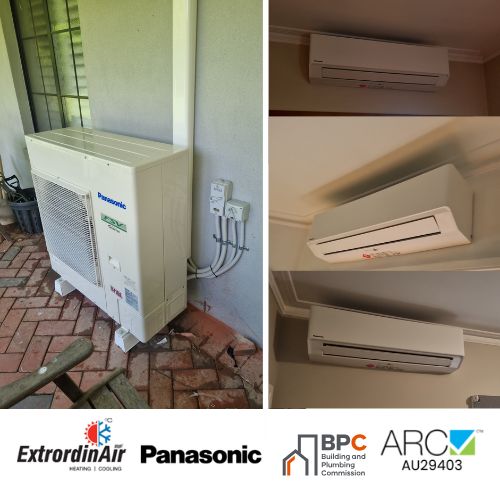
Panasonic Single Phase Mini VRF Installation
This homeowner upgraded her ducted gas heating system to a Panasonic Mini VRF air conditioner with three wall mounted heads in her Melbourne home. This VRF air conditioning system runs on single phase power, and included a deluxe wired remote controller which manages all 3 units.
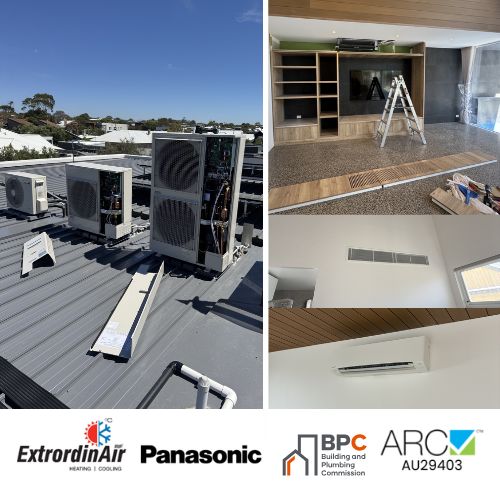
Panasonic 3 Phase Mini VRF Installation
Two Panasonic three phase mini VRF air conditioners were installed in this two storey home in Melbourne. The larger 22.4kW has four narrow bulkhead systems installed in the master bedroom, kitchen, dining, and a bedroom. The smaller 12.1kW air conditioner has 2 x slim and narrow bulkheads installed in the other bedrooms and a 5.6kW wall hung split system in the upstairs retreat area. This home has a flat roof, which is housing the outdoor compressors.
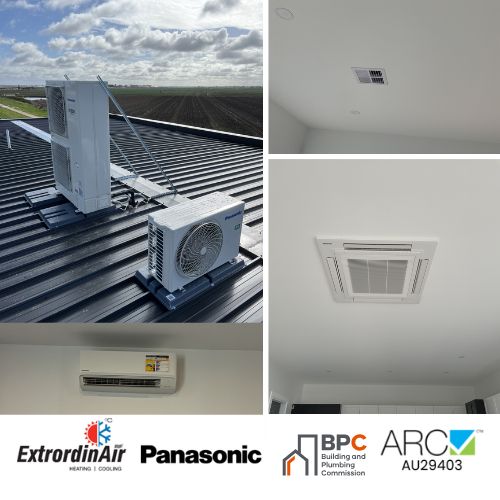
Panasonic FSV Mini VRF Installation
This Panasonic VSF Mini VRF system with side discharge on the outdoor unit has a combination of 4 way cassette heads and ducted air conditioning with 5 x outlets and 4 x zones. An additional 2.5kW split system was installed in a guest bedroom.
VRF Air Conditioning Offers Precision Climate Control for Larger Homes, Offices, and Commercial buildings across Melbourne
VRF makes sense when a standard split system isn’t enough and a standard ducted system isn’t flexible enough. Typical projects we quote for:
- Commercial fitouts: offices, medical suites, dental practices, veterinary clinics, hospitality venues, retail spaces, and gyms
- Multi-storey homes: particularly newer builds where homeowners want individual zone control on each level without one central plant running flat out to please everyone
- Heritage properties: Victorian and Edwardian homes where running full-size return-air ductwork would mean dropping ceilings or losing wall space
- Extensions and renovations: where adding a new wing to an existing system isn’t practical and a second standalone system would be inefficient
- Apartment buildings, townhouse developments, and serviced accommodation: where each unit needs to be operated independently.
If you live in a 3-4 bedroom single storey home with a fairly standard roofline and layout, a standard ducted air conditioning installation will almost always be the better value choice. VRF air conditioning systems are a premium product, when zoning, layout, or aesthetics rule the simpler options out.
How VRF differs from standard ducted refrigerated air conditioning
Both VRF and standard ducted refrigerated systems can use ductwork to deliver air into rooms. The difference is in how the system is structured behind the ducts:
| Standard ducted refrigerated | VRF / VRV | |
|---|---|---|
| Outdoor units | One condenser | One to three condensers feeding the whole building |
| Indoor units | One central fan coil distributing air through a single ductwork network | Multiple indoor units including ducted, cassette, wall, under-ceiling, or floor; each serving its own zone |
| Ductwork | One large network of supply and return ducts from the central fan coil to every room | Short, dedicated duct runs per zone, or no duct at all where wall/cassette/console units are used |
| Zoning | Motorised dampers open and close zones on a shared setpoint | Each indoor unit is genuinely independent. |
| Simultaneous heat + cool across zones | No. Choose heating, or cooling but not both at the same time. | Yes, only with heat recovery VRF systems |
| Compressor modulation | Inverter ducted systems modulate to match load, including when zones are closed | Inverter compressor modulates per zone demand |
| Best suited to | Single-family homes, predictable usage patterns | Commercial buildings, multi-storey or split level homes, mixed-use properties, anywhere with diverse loads |
| Upfront cost | Lower | Higher (typically 30–80% more depending on configuration) |
| Running cost | Lower upfront cost, zoning brings running costs down when fewer zones are in use | Comparable to a well zoned ducted air conditioning system in a typical home. Larger savings emerge in buildings with mixed thermal loads or independent zone usage patterns. |
In short, a well-zoned ducted refrigerated system handles the majority of Melbourne homes beautifully. VRF earns its premium when you need genuinely independent zone control across multiple indoor units, simultaneous heating and cooling in different parts of the building, or a layout that makes a single central fan coil impractical.
All Leading Manufacturers Offer VRF Air Conditioners for Your Home or Business
ExtrordinAir is a premium Panasonic dealer, and Panasonic VRF is the brand we install most and know best. That said, we’re not locked to one manufacturer. For jobs where another brand is the better technical or commercial fit, we’ll quote it honestly. The ranges we work with include::
- Panasonic ECOi and Mini VRF: Panasonic’s Mini VRF outdoor units are available in both single-phase and three-phase configurations, which gives us flexibility on residential properties without three-phase supply as well as on commercial sites where three-phase is standard. For larger commercial work, the Panasonic ECOi range scales up to multi-condenser configurations with heat recovery.
- Daikin VRV: The original VRV system, and still the benchmark in many commercial briefs. Strong parts and tech support network across Victoria. VRV 5, VRV IV, and Mini VRV for smaller residential applications
- Mitsubishi Electric City Multi: Strong heat recovery performance and a solid commercial track record
- Mitsubishi Heavy Industries KX: A separate company to Mitsubishi Electric; reliable mid-range pricing
- Fujitsu Airstage: Competitive on smaller commercial and large residential applications
- Hitachi Set Free: Long-established VRF range with a reputation for reliability and quiet operation
- Sanyo ECO-i: Sanyo’s air conditioning division was acquired by Panasonic in 2011, so new VRF isn’t sold under the Sanyo name any more, but legacy Sanyo VRF is still in service across Melbourne and we can service and source parts where required
- Toshiba SMMS: A strong on quiet operation
- LG Multi V and Samsung DVM: Both worth quoting on larger commercial projects


Client Reviews



Frequently Asked Questions About VRF Air Conditioning Systems
Is VRF better than split AC?
Whether VRF beats a split system comes down to how many rooms you’re heating or cooling and how independently you want to run them. VRF is the better choice for whole-building climate control across multiple zones, while a single split is still the right answer for one or two rooms. We compare VRF and multi split air conditioning in a separate blog post.
Can a VRF heat and cool at the same time?
A heat recovery VRF system can heat and cool different zones simultaneously. This is different to a heat pump VRF systems which can only heat or cool at any one time.
What are the disadvantages of VRF aircon systems?
The main drawbacks of VRF are higher upfront cost than a standard ducted system, more refrigerant pipework running through the building, and the need for installers and service technicians who genuinely know the brand.
What is the lifespan of a VRF AC?
A well-maintained VRF system usually lasts 15 to 20 years, with the compressor often being the first major component to need replacement. Neglected systems, particularly those that skip annual servicing, can fail noticeably earlier.
What are common VRF system problems?
The most common VRF issues we see in service calls are refrigerant leaks at flare fittings, dirty filters and coils reducing efficiency, condensate drain blockages on indoor units, and electronic expansion valve faults affecting individual zones.
Book a VRF Consultation for Your Melbourne Home or Business Today
Designing a VRF system properly takes a site visit, a load calculation for every zone, a look at the available space for condenser placement, and a conversation about how the building gets used. We prefer not to quote VRF off floor plans alone.
Call us on 1800 384 988 or complete our contact form below to book a no-obligation consultation. Based in Airport West, we are within easy reach of all Melbourne’s inner suburbs across the west, north, and north east.
