What is Braemar Dominator Series® 2?
If you’ve got a ducted gas heater and you’re thinking about making the switch to electric, the Braemar Dominator Series® 2 is one of the most interesting products to hit the Australian HVAC market in recent years. It’s designed to do something that used to require a full system rip-out: replace your ducted gas heater with an all-electric reverse cycle system that provides both heating and cooling.
It reuses your existing ductwork and ceiling vents, providing they are in good condition. There is still more work than a simple gas heating changeover, with an outdoor unit and refrigerant piping required (and possibly return air grille upgrades), however, a little less work than an entire new ducted air conditioning installation.
In this guide we’ll walk through how the Dominator Series® 2 works, what it can and can’t do, who it’s suited to, and what Melbourne homeowners should consider before making the switch.
Table of Contents
- What Is the Braemar Dominator Series® 2?
- Flexible Installation Options
- Technical Specifications
- Key Features Worth Knowing About
- How Does the Heating Compare to Ducted Gas?
- Zoning and Controls
- Who Is the Dominator Series® 2 Best Suited To?
- Things to Consider Before You Commit
- How Does It Compare to a Standard Ducted Reverse Cycle System?
- What Are Real Owners Saying? Honest Feedback From Australian Forums
- Is the Dominator Series® 2 a Good Fit for Melbourne?
- How Much Does the Braemar Dominator Series® 2 Cost?
- Tips for Getting the Best Performance From Your Dominator
- Braemar Dominator Brochure, Manuals and Resources
- About Braemar
- Thinking About Making the Switch?

What Is the Braemar Dominator Series® 2?
The Dominator Series® 2 is an all-electric ducted reverse cycle heating and cooling system made by Braemar (a brand of Seeley International). It’s built on a simple but powerful idea: instead of tearing out your entire ducted gas heating setup and starting from scratch with a conventional ducted reverse cycle system, the Dominator indoor unit is designed to slot directly into the same position where your gas heater currently sits.
The indoor unit connects to your existing ductwork and ceiling vents, and is paired with a new Braemar reverse cycle outdoor unit. The result is a single-phase system that provides both heating and cooling through the same ducts your gas heater has been using for years.
Braemar positions the Dominator Series® 2 as compatible with any brand of ducted gas heater. Whether you currently have a Bonaire, Braemar, Brivis, Rinnai, Stadt, Lennox, Eco Pacific or Celair unit, the Dominator is engineered to replace it.
Flexible Installation Options
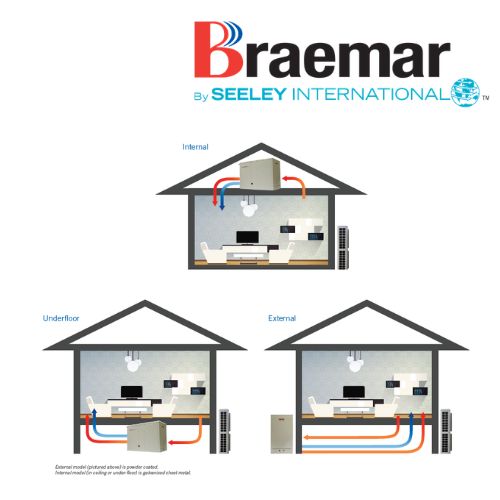
The Dominator Series® 2 can be installed in three configurations to suit different home layouts:
- Internal (in-ceiling): The most common setup in Melbourne homes. The indoor unit sits in the roof space where your gas heater was, connected to the existing ceiling ductwork and vents.
- Underfloor: For homes with sub-floor ducting (common in older Melbourne properties), the indoor unit can be installed beneath the floor.
- External: For homes where the old gas heater was mounted on an external base box. The external model features a powder-coated finish for weather protection, while internal and underfloor models use galvanised sheet metal.
Technical Specifications
Here’s a snapshot of what the Dominator Series® 2 delivers:
| Specification | Dominator Series® 2 |
|---|---|
| Rated Heating Capacity | 17.0 kW (range: 5.4–21.0 kW) |
| Rated Cooling Capacity | 13.2 kW (range: 2.3–16.8 kW) |
| Power Supply | Single phase (220–240V / 50Hz) |
| Rated Airflow | 700 L/s (range: 400–900 L/s) |
| External Static Pressure | 0–300 Pa |
| Refrigerant | R32 |
| Maximum Pipe Run | 75 m (30 m height difference) |
| Heating Operating Range | -15°C to 24°C |
| Cooling Operating Range | -15°C to 52°C |
| Indoor Unit Dimensions (W x D x H) | 1148 x 530 x 802 mm |
| Outdoor Unit Dimensions (W x D x H) | 940 x 320 x 1430 mm |
| DRED | Yes (standard) |
| Condensate Pump | Built-in (1 m lift) |
| Warranty | 5 years |
| Power Consumption (Operating) | 0.9 kW to 6.5 kW |
| Startup Time | Up to 8 minutes (7 min minimum run time) |
Key Features Worth Knowing About
Micro-Channel Heat Exchanger
The Dominator Series® 2 uses a micro-channel heat exchanger rather than a conventional tube-and-fin design. This maximises heating capacity and efficiency in a more compact unit – an important consideration when the indoor unit needs to fit into the same space your old gas heater occupied.
EC Fan Motor With Inverter Technology
The indoor unit uses the latest EC (electronically commutated) backward curve fan with inverter technology. This delivers high static pressure for pushing air through your existing duct runs, while keeping noise levels down and energy consumption low. The system can produce up to 300 Pa of external static pressure, which gives it plenty of grunt to work with longer or more complex duct layouts.
R32 Refrigerant
The Dominator uses R32 refrigerant, which has a global warming potential 68% lower than the older R410A refrigerant. It also requires up to 30% less refrigerant charge, which means a smaller environmental footprint and slightly lower running costs. Read our air conditioning refrigerants guide to learn more about why this is important.
Outdoor Coil Coating
The outdoor unit features a protective coating on the condenser coil. This is designed to resist corrosion in harsh Australian conditions and is rated at three times the protection of standard blue fin coatings. For Melbourne homes near the coast or in areas with higher salt content in the air, this is a worthwhile durability feature.
Built-In Condensate Pump
All Dominator Series® 2 units include a built-in drain pump. This makes it easier to route condensate to the nearest drain point, which is particularly helpful for in-ceiling installations where gravity drainage isn’t always straightforward.
Slim Outdoor Unit
The outdoor unit measures just 320mm deep with a slim profile, making it easier to place in tight side passages or against narrow fence lines – a common constraint in Melbourne’s inner suburbs. Pipe runs of up to 75m allow flexibility in positioning the outdoor unit well away from living areas if noise is a concern.
How Does the Heating Compare to Ducted Gas?
Like most air conditioning systems, the Dominator doesn’t heat the air to the same temperature as a gas heater, but it’s been engineered to get closer than a standard reverse cycle system:
| System Type | Air Outlet Temperature |
|---|---|
| Ducted gas heater | 53°C |
| Braemar Dominator Series® 2 | 40°C to 50°C |
| Standard ducted reverse cycle | Approximately 40°C to 43°C |
Source: Braemar Dominator Series® Owner’s Manual Insert (KGHV Series).
What does this mean? The air coming out of your ceiling vents won’t feel quite as hot as your old gas heater, but it will be noticeably warmer than what a standard reverse cycle system delivers. The Dominator heats your home through faster air changes rather than blasting ultra-hot air. Keeping internal doors open between the vents and the return air grille is important for the system to work efficiently.
At very low outdoor temperatures (below 7°C), all reverse cycle systems (including the Dominator) will produce cooler air than they would in milder conditions. Braemar recommends not letting your home drop below 16°C during unoccupied times in winter, as the system will work harder and use more energy to recover from a very cold starting point. The same principle applies in summer: don’t let the house get above 28°C before switching on cooling.
Zoning and Controls
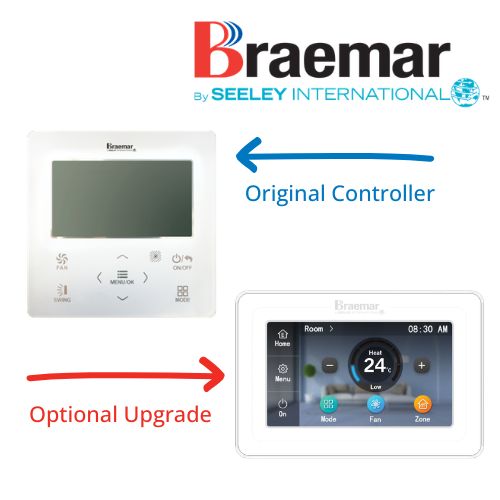
The Dominator Series® 2 comes with a standard wired wall controller (model XE71) that handles basic operation including turbo mode, energy-saving settings, a weekly timer, filter clean notifications, and the ability to read the outdoor ambient temperature.
For homeowners who want room-by-room control, there’s an optional Braemar Zone Controller upgrade. This is a touchscreen wall-mounted unit that supports 4 to 8 zones with individual temperature sensing via RF (radio frequency) remote sensors – one per zone. The system comes with 4 RF sensors as standard when the zone kit is purchased, and can be expanded to 8 zones with additional sensors. The RF sensors use CR2450 button batteries that may need replacing annually.
One important detail; the system requires one “Always On” zone that cannot be switched off. This zone must have an RF remote sensor installed in it. The remaining zones (up to 7) are switchable and can have sensors, no sensors, or a mix. Also worth noting: the standard wired wall controller does not contain a room temperature sensor – it’s purely a control panel. The actual temperature reading comes from the RF sensor in the Always On zone.
Wi-Fi control is also available as an optional add-on through the EWPE smart app, which is free on both iOS and Android. This lets you switch on the heating or cooling remotely – handy for getting the house warm before you arrive home on a cold Melbourne evening.
Who Is the Dominator Series® 2 Best Suited To?
The Dominator Series® 2 is a strong fit for Melbourne homeowners who fall into one or more of these categories:
- You have an ageing ducted gas heater that needs replacing and you’d rather switch to electric than install another gas unit. This is the core use case the Dominator was designed for.
- You want to avoid the cost and disruption of a full ducted air conditioning installation. By reusing your existing ductwork and ceiling vents, the Dominator can save thousands in installation costs compared to a ground-up ducted reverse cycle system. The Dominator Series® 2 model number (KGHV200A1S / KCHV160D1B) is on the registry for approved VEU rebates. You can search the public register here.
- You already have ducted evaporative cooling and want to add heating (and backup refrigerated cooling for humid days). The Dominator pairs well with an existing Breezair or Braemar evaporative cooler, giving you evaporative cooling for most of summer and reverse cycle for the handful of humid days where evaporative is less effective. Having said that, so does any air conditioning installation.
- You need a single-phase solution. Many older Melbourne homes only have single-phase power. The Dominator runs on standard single-phase supply, so there’s no need for a switchboard upgrade to three-phase.
Things to Consider Before You Commit
The Dominator Series® 2 is a well-designed product, but it’s worth going in with clear expectations.
- Heating capacity: The rated heating output is 17kW. That’s solid for most Melbourne homes, but if your current gas heater is a 30kW or 35kW unit heating a very large home, you’ll want your installer to run the numbers carefully to make sure 17kW (with a maximum of 21kW) is sufficient for your floor plan and insulation levels.
- Existing ductwork condition: The Dominator reuses your existing ducts, which is a major cost saver. However, if your ductwork is old, damaged, poorly insulated or undersized, it may need repair or replacement regardless of the new indoor unit. A good installer will assess the condition of your ducts as part of the changeover.
- Cooling performance in extreme heat: Like all reverse cycle systems, the Dominator’s cooling capacity can decrease as outdoor temperatures climb past 40°C. Melbourne typically sees only a handful of days above 40°C each summer, but it’s worth knowing that this is a characteristic of reverse cycle technology generally, not a limitation of this product alone.
- Warranty: The Dominator comes with a 5 year manufacturer’s warranty. This is shorter than the 7 year warranty offered on Braemar’s ducted gas heaters (from participating dealers), so keep this in mind when comparing the overall value proposition.
- Zoning costs extra: The zone controller is an optional upgrade, not included in the base system. If room-by-room temperature control is important to you, factor in the cost of the zone kit and any additional RF sensors when budgeting.
How Does It Compare to a Standard Ducted Reverse Cycle System?
The main advantage of the Dominator Series® 2 is the installation process itself. A standard ducted reverse cycle installation involves removing the old gas system, installing new ductwork throughout the ceiling, cutting new vents, repairing and painting ceilings, and coordinating multiple trades over several days.
The trade-off is that the Dominator is currently available in a single capacity (17kW heating / 13.2kW cooling), whereas conventional ducted reverse cycle systems come in a wider range of sizes to suit larger or smaller homes. If your home needs more than 21kW of heating capacity, a conventional system may be the better path.
For Melbourne homes in the typical 150–250 square metre range with reasonable insulation, the Dominator’s 17kW output should be well within the comfort zone for most winter days.
What Are Real Owners Saying? Honest Feedback From Australian Forums
The Dominator Series® 2 is still a relatively new product, so long-term owner reviews are limited. However, here’s what we found on Australian forums that give a balanced picture of what to expect.
The Positives
Installation and heating performance: One owner reported that installation went well, noting that while the return grille and return ducting needed upgrading, the supply ducting to the rooms didn’t need replacing. They found the heating performance solid, saying the system heats the house pretty well despite not producing air as hot as their old gas heater. The wireless room sensors and zoning allowed them to turn off unused rooms.
Running cost savings: A two-storey homeowner who had the Dominator installed for three months reported that their gas bill dropped from $1,500 to a $650 electricity bill – a meaningful saving.
Clever concept: Forum commenters broadly acknowledged the Dominator as a clever niche product, with one noting that Braemar has done some sophisticated engineering on the fan coil to make it perform within the airflow and static pressure constraints of existing gas ductwork.
The Criticisms
Temperature overshoot: One owner flagged that the system’s temperature control works differently from what they expected. The owner’s manual confirms this is a documented feature, not a fault: in heating mode, the compressor starts at the set temperature and stops when the room reaches 2°C above the set point. In cooling mode, it stops when the room reaches 2°C below the set point. So if you set the thermostat to 22°C for heating, the system will cycle off when the room hits 24°C, then restart when it drops back to 22°C. This wasn’t made clear to the owner during installation, which caused initial frustration – but once understood, it’s a standard inverter cycling behaviour.
Cooling limitations with existing ducts: The two-storey owner found that the downstairs level (which reused old gas ducts) struggled more than the upstairs level (which had new ducts installed). They ended up supplementing the Dominator with a split system for the main downstairs living area. This is a recurring theme in forum discussions – gas ducts are smaller than what a conventional reverse cycle system would use, and the cooling performance through those smaller ducts can be noticeably less effective than the heating. This is the main reason we don’t suggest using heating ducts for air conditioning.
Smart home integration: The same owner noted that the Dominator doesn’t have great smart connectivity – the app works but isn’t always reliable, and there’s no Google Assistant or Amazon Alexa integration. This is worth knowing if smart home control is a priority for you.
Minimum airflow requirement: Several forum users noted that the system requires a minimum of 5–6 vents to remain open at all times (the minimum airflow is 400L/s). This limits how aggressively you can zone the system – you can’t close everything down to just one or two rooms.
Value debate: Some users questioned whether the Dominator offers enough savings over a conventional ducted reverse cycle with new ductwork, particularly when the price difference may only be a few thousand dollars depending on the home. As one user put it, the Dominator’s strongest case is in homes where replacing the ductwork would be extremely difficult or expensive – for example, in homes with limited ceiling access or complex layouts.
The Bottom Line From Real Users
The consensus from forum discussions is that the Dominator is a genuinely clever product that fills a real gap in the market, but it works best in the right situation. It’s ideal when your existing ductwork is in good condition and replacing it would be costly or impractical. If your home has easy access to the ceiling and straightforward duct runs, it’s worth comparing a full ducted reverse cycle installation (with new ductwork) against the Dominator to see which offers better value for your situation.
Is the Dominator Series® 2 a Good Fit for Melbourne?
Melbourne’s climate suits reverse cycle heating. Winters are cool to cold but rarely extreme (average winter minimums hover around 6–8°C), which sits comfortably within the Dominator’s heating operating range of -15°C to 24°C. The system shouldn’t struggle to produce heat on Melbourne’s coldest mornings.
On the cooling side, Melbourne’s hot and dry summers suit the Dominator well for the days when your evaporative cooler isn’t cutting it. The 13.2kW of rated cooling capacity provides a reliable backup for those humid or extreme heat days.
Victoria’s energy landscape is also shifting in favour of electric heating. With the state government’s gas substitution roadmap and increasing electricity from renewable sources, switching from gas to an efficient reverse cycle system aligns with the broader direction of Victoria’s energy policy. The Dominator is approved under the Victorian Energy Upgrades (VEU) program, which means eligible homeowners can access rebates when replacing a gas heater.
The Dominator’s DRED (demand response enabled device) capability means it can also participate in future demand response programs, which may offer additional bill savings as the electricity grid evolves.
How Much Does the Braemar Dominator Series® 2 Cost?
As always, we can’t quote you an exact future without seeing your existing ductwork, electrical requirements, site access and whether you add zoning.
Typical installed price (after VEU rebates): $9,500 to $20,000. The wide range reflects the variation in home setups. A straightforward ceiling replacement in a single-storey home with good duct condition will sit at the lower end, while a larger home requiring duct repairs, electrical upgrades and 8-zone control will push toward the upper end.
A likely installation quote, reusing all existing ductwork, would be around the $11,000 to $15,000 range.
Before VEU rebates, expect the base cost to be higher. The rebate amount depends on the installer’s VEEC calculation and can vary based on certificate pricing.
Tips for Getting the Best Performance From Your Dominator
- Keep doors open in heated or cooled zones. The Dominator works by recirculating air through the home. Internal doors between the air outlets and the return air grille need to stay open for the system to work efficiently. In rooms that aren’t being conditioned (closed zones), keep those doors closed to help the active zones reach temperature faster.
- Clean the return air filter monthly. A dirty or blocked filter will reduce airflow, degrade both heating and cooling performance, and can lead to system breakdowns. This is more important than many homeowners realise.
- Close external doors and windows. Unlike evaporative cooling, the Dominator is a sealed system that recirculates indoor air. Leaving doors or windows open will significantly reduce its effectiveness.
- Run the system proactively, not reactively. Rather than waiting until the house is uncomfortable, Braemar recommends maintaining a set temperature throughout the day. For example, setting the thermostat to 22°C in the morning and letting the system maintain that temperature uses less energy than letting the house drop to 14°C and then trying to recover. For cooling, every 1°C below 24°C can increase running costs by up to 10%. We’ve written a detailed post on the best air conditioner temperature settings.
- Keep fan speed on high when cooling. The manual recommends running the fan at the highest comfortable speed when in cooling mode. Higher airflow improves cooling performance and helps the room reach the desired temperature faster, reducing overall running time and energy costs.
- Don’t manually close vents. Closing individual ceiling or floor vents by hand can affect system performance. Use the zone controller to manage which rooms receive heating or cooling rather than manually shutting vents.
Braemar Dominator Brochure, Manuals and Resources
Looking for official documentation? Here it is:
You can also find it on the Seeley International website.
About Braemar
Braemar is a brand of Seeley International, a 100% Australian-owned company based in Lonsdale, South Australia. Founded in 1938, Braemar has been a fixture of Australian heating and cooling for over 80 years. Seeley International is the country’s largest air conditioning manufacturer and exports to markets around the world. The Dominator Series® 2 is Australian designed and manufactured, and is backed by Seeley International’s national dealer and service agent network.