How Much Water Do Rooftop Evaporative Coolers Use in Melbourne?
If you’re weighing up an evaporative cooling installation, or you already have a rooftop unit in your Melbourne home, the big question is: how much water does it actually use? Short answer: usually less than people expect, and as low as 60 litres per hour for smaller homes on low fan speeds.
Usage does change with weather, fan speed, and how the unit manages water quality. This post keeps things simple: we’ll show you typical litres‑per‑hour, give you a handy on‑page calculator, and explain the easy tweaks that keep your cooler efficient without sacrificing comfort.
We’re talking rooftop (ducted) evaporative air conditioners from brands you see around Melbourne, such as Brivis, Braemar, Bonaire, Breezair, and Coolair.
- How Evaporative Cooling Systems Use Water
- How Airflow Affects Water Usage
- How to estimate your own usage (no specs required)
- Melbourne’s Typical 4 Seasons in One Day Affects Water Usage
- The Water Management System of Your Evaporative Cooler Also Affects Water Usage
- Do Different Brands Use Different Amounts of Water?
- How to Reduce Water Use Without Sacrificing Cooling Performance
- What About Total Running Costs Including Electricity?
- Frequently Asked Questions
- How much water does a ducted air conditioner use?
- How much water does a Breezair evaporative cooler use per hour?
- How often should an evaporative air conditioner dump water?
- Does evaporative cooling increase water bills?
- What is a downside of evaporative cooling?
- How much does evaporative cooling cost to run per day?
- What is the best humidity level for evaporative cooling?
- How can I make my evaporative aircon more water efficient?
- How much does it cost to service an evaporative cooler?
- Conclusion
How Evaporative Cooling Systems Use Water
When people ask about water consumption or water usage, they’re really asking about two things combined:
Evaporation: the water that turns into vapour to create the cooling effect as outside air passes through wet filter pads.
Water management: a little extra water used to keep minerals under control and the tank clean. Depending on the model and settings, this could be:
- a continuous bleed (a small, steady trickle to drain while running),
- periodic auto‑dumps/drains (emptying the tank at shut‑down or at set intervals), or
- smart salinity control systems that only refresh when sensors detect build‑up.
Here’s a simple formula to keep in mind as you look at the examples and try the calculator below.
Total water usage = evaporation + management (bleed/dump).
Melbourne Evaporative Cooler – Water Usage Estimator
Estimate litres per hour/day and running cost for a rooftop evaporative cooler. This tool uses a 30‑ACH design rule and an evaporation guide of 2.5 L/h per 100 L/s of airflow. Adjust inputs for your home.
How Airflow Affects Water Usage
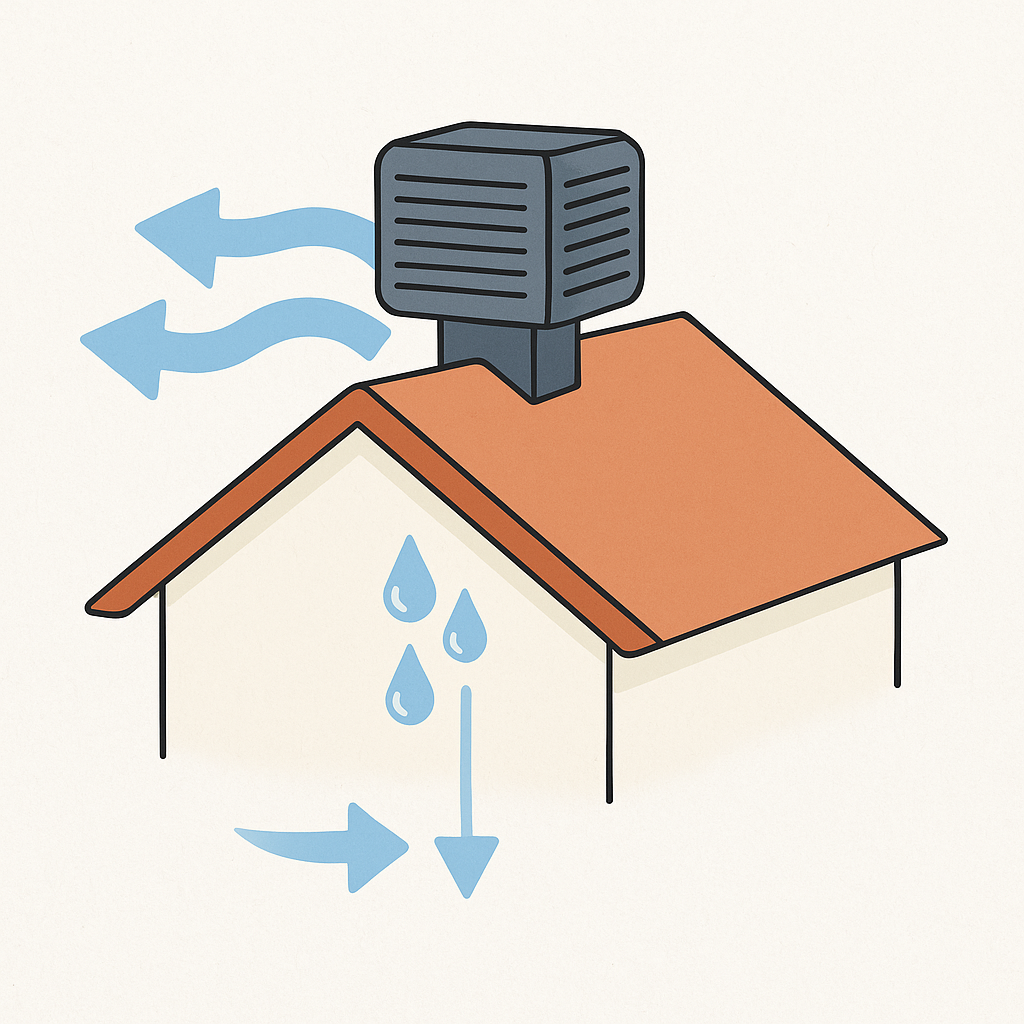
Let’s keep this super practical. Two things mainly decide how much water your evaporative air conditioner uses:
- How much air it moves (airflow), and
- How long you run it.
Manufacturers rate airflow in litres per second or cubic metres per hour. For homes, installers usually size systems by Air Changes per Hour (ACH) – how many times each hour the cooler replaces the air in the rooms you’re using. For evap systems in Melbourne, ~30 ACH is a common design target for living areas.
Here’s the handy rule-of-thumb used across the industry:
About 2.5 litres of water evaporate per hour for every 100 L/s of supply airflow.
So if your system delivers 4,000 L/s, evaporation is roughly 2.5 × 40 = 100 L/h. That’s before any extra water used for bleed or drain/dump cycles.
How to estimate your own usage (no specs required)
- Work out room volume: floor area (m²) × ceiling height (m) = m³.
- Convert volume to airflow: volume × ACH = m³/h.
- Convert to L/s: m³/h × 1000 ÷ 3600 = L/s.
- Apply the rule: L/h ≈ 2.5 × (L/s ÷ 100).
- Add water management: tack on a small percentage for bleed/refresh and any shutdown dump your unit performs.
Here are some examples based on average sized homes across Melbourne with ceiling heights of 2.6m
Small home
120 m² → volume 120 × 2.6 = 312 m³
Airflow at 30 ACH = 312 × 30 = 9,360 m³/h = 2,600 L/s
Evaporation ≈ 2.5 × (2,600 ÷ 100) = 65 L/h
Medium home
180 m² → volume 468 m³
Airflow ≈ 14,040 m³/h = 3,900 L/s
Evaporation ≈ 2.5 × 39 = 98 L/h
Large home
240 m² → volume 624 m³
Airflow ≈ 18,720 m³/h = 5,200 L/s
Evaporation ≈ 2.5 × 52 = 130 L/h
Daily water = (hourly total including bleed) × hours run (+ one tank dump if enabled).
Example: the medium home above at 98 L/h for 6 hours uses around 590L/day; if your unit does a 20L shutdown dump, that’s 610L in total.
Tip: If you mainly cool a few living zones rather than the whole house, your effective area (and water use) will be lower. For a quick check, plug your own numbers into the calculator below.
Melbourne’s Typical 4 Seasons in One Day Affects Water Usage
Evaporative coolers work best on hot, dry days. In Melbourne, summer afternoons are often relatively dry, which improves the cooling effect but also increases the evaporation rate while the unit is running.
On hot, drier afternoons (e.g., northerly winds), expect higher L/hr because more water can evaporate.
On humid afternoons (e.g., after a storm), the cooler’s effectiveness drops and the system may need to run longer to achieve comfort – similar daily litres, but spread across more run time.
In short: drier air → stronger cooling effect but more litres per hour; humid air → weaker cooling effect, possibly longer runtime.
The Water Management System of Your Evaporative Cooler Also Affects Water Usage
Water quality in Melbourne is generally good, but dissolved minerals still concentrate as water evaporates. To protect pads, pumps and tanks, rooftop evaporative coolers use one or more of the following:
- Continuous bleed (Braemar/Bonaire/Coolair entry models and older units): a small, steady trickle while running to dilute salts. Typical real‑world bleed settings add somewhere in the range of ~5–15% on top of the evaporated water, depending on local water quality and the installer’s setup.
- Automatic drain/dump valve (common on Breezair/Braemar/Coolair variants): periodically empties the tank at shutdown or at intervals. This uses a fixed number of litres per dump (the tank volume), rather than a continuous trickle.
- Sensor-based water management (e.g., Breezair WaterMiser®, Brivis AutoRefresh): refresh cycles are triggered by salinity probes or fill‑cycle counts, reducing waste water on good‑quality supplies.
What this means for your bill:
A well‑tuned system on Melbourne mains water might add ~5–12% to evaporation for bleed and periodic refreshes.
Poorly tuned or very conservative settings can add 15–25% (or more) – and shorten pad life. Get your installer to review the bleed rate and dump frequency at commissioning and your annual evaporative cooling service.
Do Different Brands Use Different Amounts of Water?
All leading rooftop brands in Melbourne use the same cooling physics and similar pad materials, so the biggest water‑use differences come from:
- Airflow capacity (model size) vs your home’s required ACH
- Pad area/thickness and saturation efficiency
- Water‑management approach (continuous bleed vs auto‑drain vs sensor‑based)
- Control strategy (fan speed, pre‑wet cycles, filter clean cycles)
Examples of features you’ll see in spec sheets and manuals:
- Brivis (Rinnai) – models with AutoRefresh style tank flush after a set number of fills; optional dump valves on some series.
- Braemar – some series use continuous bleed; others include an auto drain valve. Installer‑set bleed tables are common.
- Bonaire – units typically offer both dump valve and bleed control, with touchpad settings to suit water quality.
- Breezair – many models incorporate WaterMiser® salinity probes and an auto drain valve.
- Coolair – similar to Braemar/Breezair families (same parent manufacturer) with continuous bleed on some ranges and optional drain valves on others.
How to Reduce Water Use Without Sacrificing Cooling Performance
Size correctly: A right‑sized unit (≈30 ACH) won’t need to run flat‑out all day. Oversizing can waste water at high fan speeds; undersizing runs longer with less comfort.
Tune water management: On good‑quality mains water, a modest bleed rate and infrequent dumps are usually sufficient. Ask for a sensor‑based refresh if your model supports it.
Keep pads and tank clean: Dirty pads reduce saturation efficiency, so you run longer (more water, more electricity). Replace pads per manufacturer schedule.
Ventilate properly: Keep enough windows/vents open so the fresh, cool air flows through and out – this maintains the cooling effect and shortens runtime.
Use smart control: Pre‑cool the house before the hottest hour, then drop to a lower fan speed. Run only the zones you’re using.
What About Total Running Costs Including Electricity?
Water: Use the calculator below for your litres and cost per day. Melbourne water usage charges are typically a few dollars per kilolitre (kL), so even 500–800 L on a hot day often equates to just a few dollars in water – provided your bleed/dump settings are sensible.
Electricity: Evaporative cooling systems mainly run a fan and a small pump; electricity costs are usually low compared to reverse cycle air conditioning. We compare evaporative cooling vs air conditioning in this post.
According to a document prepared for waterrating.gov.au evaporative cooling is usually cheaper to run than reverse-cycle air con because it uses far less electricity. It also eases peak demand on the grid compared with refrigerated systems.
Sustainability VIC also has a handy page comparing running costs of different cooling systems.
Frequently Asked Questions
How much water does a ducted air conditioner use?
Ducted refrigerated systems use no water. Ducted evaporative air conditioners do use water, between 60 to 130 litres per hour for a whole‑home Melbourne unit while running.
How much water does a Breezair evaporative cooler use per hour?
It depends on model size, fan speed and weather. A whole‑home Breezair rooftop unit in Melbourne commonly uses between 60 to 120L per hour while running, plus any bleed/dump water.
How often should an evaporative air conditioner dump water?
Many units perform one tank dump at shutdown each day; sensor‑based systems only dump when salinity is high. Our technicians will set your schedule based on Melbourne’s mains water, as excessive dumps waste water without improving cooling.
Does evaporative cooling increase water bills?
Evaporative cooling may increase your water bills by $1 to $3 per day. This is roughly 300 to 800L on a hot day for a typical home, assuming water prices are around $3-4 per kL.
What is a downside of evaporative cooling?
One downside of evaporative cooling is performance drops in humid weather. You also need open windows and/or vents for airflow, which won’t suit every home or security preference.
How much does evaporative cooling cost to run per day?
For a typical Melbourne home, evaporative cooling costs around $3 to $5 per day for water and electricity combined.
What is the best humidity level for evaporative cooling?
Evaporative systems work best in dry air. <50% relative humidity (RH) is ideal (20–40% is excellent). Above 60% RH, the cooling effect falls noticeably.
How can I make my evaporative aircon more water efficient?
Service the unit pre‑summer, keep pads clean, ensure good cross‑ventilation, use sensor‑based tank refresh where available, and have your technician set modest bleed/dump rates for Melbourne water quality.
How much does it cost to service an evaporative cooler?
At ExtrordinAir, we charge $330 incl GST for an evap cooling service for a single storey home. Double storey or difficult access incur extra charges. Please reach out to us for a quote.

20 Years
Experience

Professional
and Licensed

24 Hour
response time

Parts and labour
Guaranteed

Residential
& Commercial

Service
Melbourne Wide

No hidden
Cost

Clean Installation
Service