Panasonic vs Samsung Air Conditioners
Are you stuck on the fence choosing between Panasonic vs Samsung air conditioners?
Both brands make excellent reverse cycle systems for Melbourne homes, and each has clear strengths. As leading Panasonic dealers, we know that range inside out. We also service and install Samsung air conditioners, which have some interesting new features, especially for bedrooms.
In this post, we compare the two brands to bring you an informed choice.
Table of Contents
Panasonic vs Samsung – Our Quick Verdict
- Living areas: Panasonic offers slightly more efficient winter heating
- Bedrooms: Samsung has quieter operation and more gentle cooling, especially if you choose a Wind Free option
- Multi Splits: Both brands have something to offer here
- Ducted: We like Panasonic for its built in Nanoe X air purification
Best for living areas: Panasonic Z Series
We chose Panasonic as the better choice for living areas in Melbourne based on winter heating. Both Panasonic and Samsung are comparable when used in cooling mode, however, when you compare a 5kW air conditioner, it’s Panasonic’s Z Series that offers a higher energy star rating for heating.
For the 5 kW models compared, Panasonic Z50 has two cold climate heating stars, while Samsung GEO AR18 D Series has 1.5. Put simply, it turns electricity into warmth more efficiently on chilly days, which in turn, may cost you less to run.
The Z Series also brings nanoe X air purification, a feature that can help reduce smells from cooking and inhibit the activity of selected bacteria, viruses and allergens. Samsung does have its own version of air purification, which we discuss further down the page.
Where Samsung shines: if your household already runs on SmartThings, or you love gentle cooling around the sofa in summer, a Samsung WindFree is a lovely living room choice.
Best for bedrooms: Samsung WindFree
Samsung WindFree is our bedroom pick for anyone who dislikes cold air blowing over them at night. Once the room reaches temperature, WindFree releases cool air through thousands of tiny holes. The result is a calm, still coolness that feels like a naturally cool room.
It’s also impressively quiet. The 2.5 kW model runs as low as 17 dB, a touch below Panasonic’s 19 dB at the same size.
Good to know: WindFree works in cooling, dry and fan modes. In winter, heating uses the regular airflow. Quiet mode switches WindFree off, so choose whichever feels best on the night.
Where Panasonic shines: if allergies, pets or dust are on your mind, a Panasonic Z Series brings nanoe X purification into the room where you spend a third of your life.
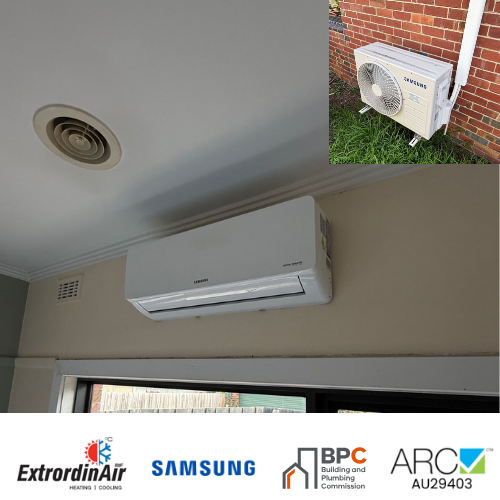
Best for multi head systems: Samsung for Smart Homes, Panasonic for Air Purification
With a multi head split system installation, up to five indoor units connect to one outdoor unit. It’s a great fit for townhouses and homes with limited outdoor space. Both brands offer one.
Samsung wins here for flexibility and control. You can mix WindFree wall units in bedrooms with cassettes or concealed bulkhead units elsewhere, then run every room from the SmartThings app. WiFi is built into the outdoor unit, so setup is simple.
Where Panasonic shines: choose Panasonic Z Series indoor units and you’ll enjoy nanoe X purification across several rooms. Panasonic also offers app control via WiFi.
With either brand, keep two things in mind:
- All indoor units share the outdoor unit’s capacity. We size it around the rooms you use at the same time. Generally, multi-splits aren’t designed to run all heads at the same time.
- You can switch individual rooms on or off and set their temperatures separately. Active indoor units must operate in the same heating or cooling mode.
Best for ducted: Panasonic
For ducted air conditioning installation in Melbourne, Panasonic is our preferred choice. Good things to know when comparing the two:
- Both Samsung and Panasonic offers a mini-VRF range for larger homes or for those who want more control over usage and heating and/or cooling settings. You’ll find Samsung’s in their business air conditioners section, it is named DVM S Mini Heat Recovery. Learn more about VRF air conditioning here.
- Panasonic have built in Nanoe X air purification in their NX ducted systems. At the time of writing, air purification in Samsung is limited to selected wall mounted split systems and ceiling cassettes.
Where Samsung shines: Samsung’s ducted range delivers similar heating output with built in WiFi and FreezeWash coil cleaning. The coil cleaning is a new feature across selected Samsung wall mounted, multi split and ducted models. We’re pretty impressed with this.
Selected Panasonic cassette models have inside cleaning, which dries the unit and uses Nanoe X.
Also, if you use AI assisted home tools such as Samsung Bixby, Amazon Alexa or Google Assistant, the in-built Wi-Fi and Samsung Smart Things app connects to these.
On compatible models, a linked Galaxy watch or ring can activate Good Sleep mode when you fall asleep. The air conditioner then adjusts its target temperature through a programmed sequence to help you maintain a deep sleep. It’s important to note that it doesn’t adjust in real time based on your sleep stages – it’s not that smart (yet!).
With ducted systems, good design matters as much as the brand. Outlet placement, duct insulation and zoning all shape how comfortable your home feels.
Running costs: heating is where you’ll notice the difference
In Melbourne, winter heating usually makes up the bigger share of your air conditioning bill. When you compare energy labels, look at the cold zone heating stars. Read our post on aircon energy ratings for more information.
Here’s what that looks like for two 3.5 kW wall splits producing the same amount of heat:
| Matched 3.5 kW systems | Rated heating electricity input | Cost at the rated test point |
|---|---|---|
| Panasonic Z35, producing 4.0 kW heat | 0.87 kW | Approximately 23c an hour |
| Samsung GEO AR12 D Series, producing 4.0 kW heat | 1.05 kW | Approximately 27c an hour |
These figures use 25.96 cents per kWh, the 2026–27 Victorian Default Offer flat rate for the CitiPower network, at the standard heating test point. Your tariff, daily supply charge, insulation, thermostat setting and hours of use will impact your own costs.
Both Systems Offer Air Purification, But They Work Differently
Panasonic’s nanoe X uses tiny water particles to carry reactive molecules around the room. It has been approved by the National Asthma and Council Australia’s Sensitive Choice program.
Here’s how it works:
- It collects moisture from the air. There is already a small amount of invisible water in the air around you.
- It uses electricity to create tiny water particles containing “hydroxyl radicals”. Think of these radicals as tiny chemical helpers.
- The air conditioner’s fan spreads them around the room. They can reach substances floating in the air and some that have settled on curtains, cushions and other surfaces.
- The radicals react with certain substances. They can take hydrogen atoms from those substances, changing their structure. This can reduce some smells and make certain bacteria, viruses and allergens less active.
For example, nanoe X can help reduce some odours trapped in fabric. The effect depends on the type of smell, room size and how long the system runs. The air conditioner’s filters still collect dust and need regular cleaning. Nanoe X adds another way to help improve the air.
Samsung’s Quad-Care filter captures particles as air passes through its filters. The air conditioner draws in room air, and the filter catches dust, including tiny particles as small as PM2.5. Its filter materials also have tested effects against certain bacteria, viruses and allergens that come into contact with them. The fan then circulates the filtered air back into the room.
Warranty and Servicing – Selected Samsung Models Offer up to 10 Years Parts Warranty
Panasonic and Samsung both offer a five year parts and labour warranty on residential air conditioners, across all their sizing and ranges.
At Samsung, Airise and Aero products are covered by an additional 5 years parts only warranty on their digital inverter compressors.
As always, manufacturer terms and conditions apply so please read the fine print and conditions attached (like professional servicing) to the model you choose.